AVs, Flying Taxis, AI & Delivery Bots at Transportation Research Arena 2026 in Budapest, Hungary
The Transportation Research Arena (TRA) 2026 in Budapest brought together transportation leaders from more than 70 countries to discuss the future of mobility, infrastructure, technology, and regulation. As Europe’s largest transportation research and innovation conference, TRA has long served as a forum where researchers, policymakers, regulators, operators, and industry leaders can exchange ideas and explore the challenges facing transportation systems worldwide. This year’s conference took place at a particularly important moment. Across nearly every mode of transportation, technologies that were once considered futuristic are moving into real-world deployment. Autonomous vehicles are expanding into new markets; autonomous freight carriers are operating on public highways; delivery robots are becoming increasingly common in urban environments; and advanced air mobility developers are preparing for the first generation of commercial electric air taxi operations.

The pace of innovation on display in Budapest was impressive. However, throughout the conference’s discussions, presentations, and meetings, a common theme emerged: innovation is no longer the primary obstacle to deployment. The greatest challenge facing next-generation mobility is the development of the regulatory, operational, and governance frameworks that can keep pace with technological advancement.
This January, at the Transportation Research Board (TRB) Annual Meeting in Washington, D.C., I had the opportunity to join international transportation leaders at the Embassy of Hungary in Washington, D.C., together with leaders from the U.S. Department of Transportation (USDOT) and the TRB, to discuss the significance of TRA and the growing importance of international cooperation in transportation policy. Those discussions continued throughout the conference and reinforced a message that transportation regulators have increasingly recognized in recent years: no country will solve these challenges alone.
At TRA 2026, I delivered a keynote presentation entitled, “Deploying Next Generation Transport Innovations: What Will Truly Redefine Passenger Mobility and Freight?” I examined how autonomous vehicles, autonomous freight, delivery robots, advanced air mobility (AAM), and artificial intelligence are transforming transportation systems in the United States and around the world. And I explored the central question facing policymakers and regulators: while the technologies themselves are advancing rapidly, are our regulatory institutions, governance frameworks, and operational models evolving quickly enough to support them? The answer, I suggested, will ultimately determine not only how quickly these innovations are deployed, but whether they can achieve their full potential safely, efficiently, and equitably.

At the TRA Budapest Gala, (from left) Renee Rogers, founder and CEO of Ono; Matthew W. Daus, Esq, President of the International Association of Transportation Regulators (IATR); József Attila Szilvai, Chief Executive Officer (CEO) of Magyar Közút Nonprofit Zrt; Camille Kamga, Professor and Director at University Transportation Research Center and at The City College of New York.
Deployment is No Longer Theoretical
One of the key takeaways from my keynote was that the conversation has shifted from whether emerging transportation technologies will be deployed to how quickly they can be deployed safely and responsibly. As an example, the pace of autonomous vehicle deployment accelerated significantly throughout 2025 and into 2026, led by Waymo’s continued expansion of commercial robotaxi service. Waymo now provides hundreds of thousands of paid rides each week across Phoenix, San Francisco, Los Angeles, and Austin, while preparing additional deployments in Atlanta, Miami, and Washington, D.C. As operational experience grows and safety data accumulates, autonomous ride-hailing is prompting regulators, transit agencies, and mobility providers to begin planning for broader integration.
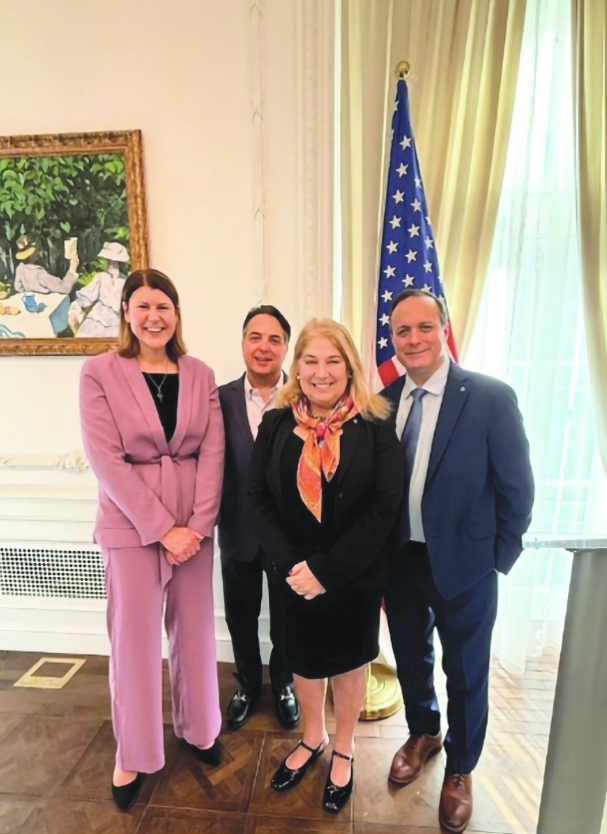
At the Hungarian Embassy in Washington, D.C., (from left) Victoria Sheehan, Highways and Roads Director at HDR; Matt Daus; Seval Oz, Assistant Secretary of Transportation for Research and Technology at the USDOT; Michael Rutherford, Assistant Secretary of the Office of Multimodal Freight Infrastructure and Policy at USDOT.
Waymo’s growth is part of a larger wave of deployment activity across the industry. Zoox continues testing and preparing for commercial service in Las Vegas, San Francisco, Miami, Austin, Seattle and other cities. At the same time, May Mobility has expanded autonomous shuttle and microtransit operations in several U.S. communities. Major ride-hailing platforms are also positioning themselves to play a central role in the autonomous ecosystem. Uber recently unveiled its robotaxi service partnership with Lucid and Nuro, combining Lucid’s Gravity electric vehicle platform, Nuro’s Level 4 autonomous driving technology, and Uber’s global ride-hailing network, with commercial service expected to launch in the San Francisco Bay Area.
Lyft, meanwhile, has pursued multiple autonomous vehicle strategies, including a partnership with Tensor to develop consumer-owned “Lyft-ready” autonomous vehicles that can be deployed on the Lyft platform when not in personal use, as well as fleet-based robotaxi initiatives with other autonomous technology partners.
At the same time, the most significant development in autonomy today may be autonomous freight. Unlike passenger transportation, which must navigate complex urban environments and address significant consumer trust concerns, freight transportation often operates under more predictable conditions. As a result, autonomous trucking has become one of the first sectors to demonstrate a clear pathway toward large-scale commercial deployment.
Companies including Aurora, Gatik, and Kodiak Robotics have already accumulated hundreds of thousands of autonomous miles and established partnerships with major logistics and retail companies. Driverless freight operations are becoming part of the transportation supply chain. In many respects, autonomous freight may become the proving ground that shapes public perception and regulatory approaches for autonomous passenger vehicles.
Regulation Has Become the Bottleneck
While deployment continues to accelerate, regulatory frameworks have struggled to keep pace. Autonomous vehicle regulation in the United States remains highly decentralized. Over 20 states have enacted legislation permitting autonomous vehicle deployment, while others continue to restrict operations to testing programs. Requirements often vary considerably, including insurance standards, law enforcement interaction protocols, operational restrictions, and certification requirements. Some states have sought to become “early adopters,” while others remain cautious observers. However, a more unified U.S. regulatory framework is taking shape. In 2025, Transportation Secretary Sean Duffy unveiled a new USDOT and NHTSA Automated Vehicle Framework designed to accelerate deployment while maintaining federal oversight of safety performance. The framework emphasizes three goals: prioritizing safety, reducing unnecessary regulatory barriers, and enabling commercial deployment at scale. In June 2025, NHTSA announced reforms to its Part 555 exemption process, which allows manufacturers to deploy limited numbers of vehicles that do not comply with traditional Federal Motor Vehicle Safety Standards. The changes are intended to speed review of applications involving purpose-built autonomous vehicles that lack steering wheels, pedals, or mirrors, reducing approval timelines from years to months. These efforts have already influenced the review of new autonomous vehicle deployments, including Zoox’s petition to operate purpose-built robotaxis without traditional driver controls.
Meanwhile, Congress is considering broader legislation, the BUILD America 250 Act (H.R. 8870). The House Transportation and Infrastructure Committee has approved this bipartisan, five-year, $580 billion surface transportation reauthorization bill. Among its many provisions, the legislation would establish the first federal regulatory framework for autonomous commercial motor vehicles, creating a pathway for Level 3, 4, and 5 automated vehicles to operate under a more uniform national system rather than the current patchwork of state regulations. The proposal would grant the USDOT additional oversight authority and direct the agency to develop standards and guidance for automated commercial vehicle operations. Although focused primarily on freight and commercial applications, the measure reflects growing congressional recognition that autonomous transportation is moving from the testing phase into widespread deployment.
Unlike autonomous vehicles, advanced air mobility falls almost entirely under federal jurisdiction of the Federal Aviation Administration (FAA). No state or municipality can independently authorize commercial eVTOL (electric vertical take-off and landing) passenger operations, meaning the pace of deployment is largely tied to the federal certification process and the development of supporting operational rules. Significant progress has been made over the past two years. The FAA’s issuance of the Powered-Lift Special Federal Aviation Regulation established a new pilot certification framework specifically tailored to eVTOL aircraft. At the same time, Engineering Brief 105A created the first comprehensive federal design standards for vertiports. Together, these actions addressed two of the most significant regulatory gaps facing the industry and provided greater certainty for manufacturers, operators, airports, and infrastructure developers.
Federal policymakers have also begun shifting from simply regulating aircraft to preparing for commercial operations. In March 2026, the FAA selected eight state and local government partners for the eVTOL Integration Pilot Program, including major initiatives in Florida, New York, and Texas. The program is intended to generate real-world operational data, test infrastructure concepts, evaluate community integration strategies, and help regulators better understand how these aircraft will function within existing transportation systems. Meanwhile, Congress continues to consider additional aviation modernization measures to streamline certification timelines and provide greater regulatory certainty as aircraft manufacturers move toward commercial service. Recent proposals, including provisions contained in the Aviation Innovation Act, would direct the FAA to establish clearer review timelines, modernize certification processes for emerging aircraft technologies, and support the development of vertiport infrastructure and airspace integration strategies. Supporters argue that such reforms are necessary to maintain rigorous safety standards while ensuring the United States remains competitive in the global race to deploy advanced air mobility systems.
The industry itself is increasingly transitioning from prototype development to network planning. Joby Aviation remains the furthest along in the FAA certification process and is operating demonstration projects in New York and New England. Archer Aviation has expanded infrastructure partnerships in California and Florida and is positioning its Midnight aircraft for deployment ahead of the 2028 Los Angeles Olympic Games. In New York, eVTOL charging infrastructure is being developed at the Downtown Manhattan Heliport, while Florida’s statewide network planning efforts and Texas’ regional advanced air mobility corridors are beginning to provide a blueprint for how future commercial systems may operate.
Despite this progress, one of the industry’s most significant challenges remains unresolved: urban traffic management. While regulators have made substantial progress in certifying aircraft, pilots, and vertiports, the systems needed to safely coordinate potentially thousands of daily low-altitude flights across metropolitan areas are still under development. Future operations will likely depend heavily on artificial intelligence, automation, digital communications networks, and entirely new approaches to airspace management. Again, the challenge facing advanced air mobility is no longer whether the aircraft can fly, but whether regulators, infrastructure providers, and operators can develop the frameworks necessary to manage these aircraft safely, efficiently and at scale.
Artificial Intelligence is Becoming Transportation’s Common Platform
I also pointed out that all these new technologies increasingly share a common foundation: artificial intelligence. AI now serves as the core operating system behind many next-generation transportation applications. Computer vision systems use AI to interpret roadway conditions and identify potential hazards. Machine learning algorithms help predict the behavior of surrounding vehicles, pedestrians, and cyclists. Simulation environments allow developers to test millions of operational scenarios at a pace that would be impossible to recreate in the real world. Remote monitoring systems combine human oversight with AI-driven decision support to improve operational safety. AI also enables continuous learning. Rather than improving one vehicle at a time, operators can apply lessons learned across entire fleets. Every trip, delivery, and flight generates data that can be used to improve future performance.
Advanced air mobility presents an especially compelling example. Future urban air transportation networks will likely rely heavily on AI-driven routing, weather analysis, conflict detection, and traffic management. Coordinating large-scale low-altitude operations simply cannot be achieved through traditional methods alone. At the same time, increased reliance on AI raises important policy questions involving transparency, accountability, cybersecurity, privacy, and workforce impacts.
Why International Cooperation Matters
Transportation innovation is a global endeavor. The United States, Europe, the Middle East, and the Asia-Pacific regions are each developing expertise in autonomous mobility, advanced aviation, digital infrastructure, artificial intelligence, and transportation regulation. No single country has yet developed a complete blueprint for managing the transition to next-generation mobility.
This reality makes international cooperation increasingly important. Sharing safety methodologies, certification approaches, operational experiences, and regulatory best practices can help avoid duplication of effort and accelerate responsible deployment worldwide. The standards being developed today will shape transportation systems for decades to come. Regulators, researchers, and industry leaders therefore have a shared interest in ensuring those standards reflect practical experience and global perspectives.
The Regulatory Agency of the Future
For more than a century, transportation regulation has generally been organized around distinct modes. Separate agencies often oversee taxis and for-hire vehicles, public transit, trucking, aviation, ports, rail systems, and other transportation services. While this structure made sense in a world where transportation modes operated largely independently, emerging technologies are increasingly blurring those traditional boundaries.
Consider the future mobility ecosystem that many participants at TRA envision. A traveler might use an autonomous shuttle to reach a transit station, connect to an advanced air mobility service for regional travel, and receive goods delivered by autonomous robots operating on local sidewalks. Freight operators may combine autonomous trucks, ports, rail facilities, and AI-powered logistics systems into a single integrated supply chain. These services will generate vast amounts of operational data, rely upon common digital infrastructure, and raise overlapping questions involving safety, cybersecurity, privacy, workforce impacts, insurance, and public accountability.
Many regulatory structures, however, were not designed for this level of integration. This issue is a major focus of IATR’s ongoing collaboration with PIARC (the World Road Association), including the development of the “Mobility Agency of the Future” initiative. The project examines how transportation regulators can modernize their structures, operations, and oversight models to better address emerging technologies and increasingly multimodal transportation systems. Among the questions being explored are how agencies can improve coordination across transportation modes, streamline regulatory processes, incorporate data-driven decision-making, and create governance frameworks that remain flexible as technology continues to evolve.
The goal is not deregulation, but rather smarter regulation. The most successful regulatory agencies of the future will be those capable of protecting public safety while supporting innovation, encouraging investment, and maintaining public trust. As autonomous vehicles, advanced air mobility, artificial intelligence, and new mobility services continue to mature, regulators themselves must evolve alongside them.
Transportation agencies will play a central role in determining how quickly and effectively these technologies are adopted. While the private sector will continue leading much of the technological development, governments and regulators must establish the rules, standards, and policy objectives that provide certainty for industry while ensuring that innovation delivers public benefits. In many respects, the future of mobility will depend as much on institutional innovation as on technological innovation.
This philosophy has guided much of IATR’s work in recent years. Through our Autonomous Vehicle Guiding Principles initiative, IATR has focused on issues including safety, sustainability, accessibility, affordability, data privacy, workforce development, governance, planning, risk management, and insurance. These principles recognize that successful deployment requires balancing innovation with public accountability.
Similarly, IATR’s ongoing collaboration with PIARC continues to explore how transportation agencies can adapt to disruptive technologies and evolving service models. The Mobility Agency of the Future initiative seeks to identify best practices from around the world and provide a roadmap for regulators navigating increasingly complex mobility ecosystems.
Looking Ahead
International collaboration on display at TRA 2026 demonstrated that the future of transportation is arriving faster than many anticipated. Autonomous vehicles are expanding. Autonomous freight is generating commercial value. Delivery robots are reshaping urban logistics. Advanced air mobility is approaching operational reality. Artificial intelligence is becoming deeply integrated into transportation systems across every mode.
The challenge now is ensuring that governance frameworks advance alongside it. For transportation regulators, researchers, policymakers, and industry leaders, the task is now to create regulatory environments that encourage innovation while protecting safety, accessibility, affordability, sustainability, and public trust. This will require ongoing collaboration across borders, disciplines, and sectors.
Budapest proved to be an especially fitting host for TRA 2026 given Hungary’s growing commitment to transportation innovation and digital infrastructure. In recent years, the city and national government have pursued an ambitious strategy that combines traditional infrastructure investment with cutting-edge mobility technologies. Budapest’s transit agency, BKK, is developing a sophisticated mobility data platform with the long-term goal of creating a digital twin of the city’s transportation system, while the BudapestGO app and expanding contactless fare payment initiatives provides their millions of users a modernized customer experience. At the same time, major investments are underway in rail and tram modernization, including the completed reconstruction of the M3 metro line and planned upgrades and extensions to the historic M1 line.
Hungary has also become a leader in connected and automated infrastructure. The M1–M7 smart motorway corridor near Budapest, which features dozens of sensor types and a real-time digital twin capable of modeling vehicle movements and roadway conditions, has emerged as one of the most advanced intelligent roadway projects in the world. Complementing these efforts are several European Union-supported smart city and logistics initiatives that use digital twins and data analytics to optimize urban freight and support sustainable mobility.
As transportation systems continue to evolve, forums like TRA will become even more important in helping shape a future that is innovative, safe, equitable, and sustainable. The future of mobility will not be determined solely by technological breakthroughs but by the ability of governments, regulators, researchers, and industry leaders to work together to create frameworks that enable innovation to flourish while serving the public interest.
Professor Matthew W. Daus, Esq. is President, International Association of Transportation Regulators (http://iatr.global/); Transportation Technology Chair, City University of New York, Transportation Research Center at The City College of New York (http://www.utrc2.org/); and Partner and Chairman, Windels Marx Transportation Practice Group (http://windelsmarx.com). He can be reached at mdaus@windelsmarx. com or 212.237.1106.


