Preventing & Managing Government Audits & Investigation
Last month, I delivered a keynote speech at the Non-Emergency Medical Transportation Accreditation Commission (NEMTAC) annual conference, held in Orlando, Fla. My presentation examined the federal dynamics leading to a startling increase in the number of state and federal investigations into NEMT businesses and discussed proactive steps that these businesses can take to maintain compliance and avoid these disruptive – and potentially disastrous – investigations.
Founded in 2018, NEMTAC’s mission is to create a high standard of care for the non-emergency medical transportation industry by establishing standards for high-quality customer service, ethical business practices and safe vehicle operations. Any organization that receives NEMTAC accreditation will be able to demonstrate to its customers that it has exceeded the minimum requirements and achieved the Non-Emergency Medical Transportation (NEMT) industry standard of excellence. The NEMTAC certification can and should help in terms of defending and managing audits and investigations, and it is very important to look into applying for and obtaining this certification – as it could help save the day for your company.
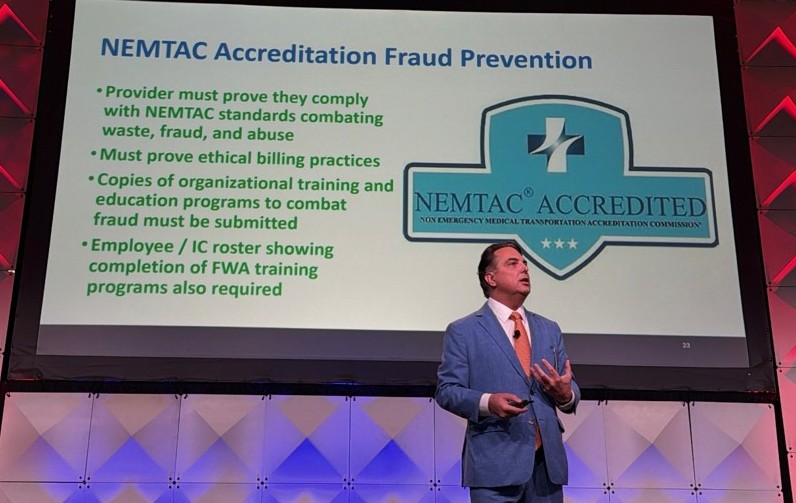
Matt Daus delivers keynote speech at Non-Emergency Medical Transportation Accreditation Commission (NEMTAC) annual conference in Orlando, Florida.
The NEMT sector is entering an unprecedented period of regulatory pressure and prosecutorial oversight. Medicaid, unlike Medicare and private health insurance, mandates the provision of transportation to and from medical services for beneficiaries who need it. The federal administration has made eliminating fraud within Medicaid a priority. That focus is reflected in federal statutory changes, pressure on state budgets, and the use of new advanced data analytics. NEMT has emerged as a primary target for audits and enforcement actions by federal and state regulatory agencies.
At the federal level, 2025’s One Big Beautiful Bill Act reshaped healthcare funding by setting a target for over $900 Billion in Medicaid savings over ten years. The expiration of pandemic-era federal funding has forced individual states to absorb higher costs. States are under a lot of pressure to close budget gaps, and their Medicaid Fraud Control Units (MFCUs) are accordingly using new techniques such as cross-agency data matching and algorithmic billing reviews to identify instances of waste, fraud and abuse.
The pressure to find fraud has increased this year. A March 2026 Executive Order created a specialized Task Force to Eliminate Fraud, chaired by Vice President J.D. Vance. Following this mandate, the U.S. Department of Health and Human Services Office of Inspector General (HHS-OIG) issued a letter to all state Attorneys General in May 2026 demanding rigorous MFCU compliance. Congressional scrutiny has intensified as well. In March 2026, leaders of the House Energy and Commerce Committee sent inquiry letters to ten state Medicaid directors demanding documentation on program integrity efforts. The Committee explicitly highlighted NEMT as a key area of Medicaid vulnerability, referencing multi-million-dollar fraud schemes, including a $3.3 million Colorado case where Medicaid was billed for trips after beneficiaries had died.
This close attention has led to a wave of criminal indictments across the nation:
- New Mexico: A driver entered a guilty plea in July 2026 for operating a multi-year scheme submitting false NEMT trip claims.
- New York: A federal grand jury in Albany indicted three individuals for healthcare fraud, wire fraud, and kickbacks linked to Medicaid transportation services.
- Ohio: State authorities launched a sweeping probe into relaxed oversight that enabled ghost trips, inflated mileage claims, and a lack of real-time verification.
There is no reason to think that this trend in increased Medicaid enforcement, and on NEMTs specifically, will slow down. Nationally, MFCUs secured 1,185 convictions and recovered over $2 billion in 2025, generating a return of $4.64 for every
$1 spent on these audits/investigations. States are fundamentally shifting from traditional “pay and chase” recovery models to proactively blocking payments. Minnesota, for example, introduced Provider Enrollment Risk Assessments, mandatory prepayment claims reviews and expanded Electronic Visit Verification (EVV) for NEMT.
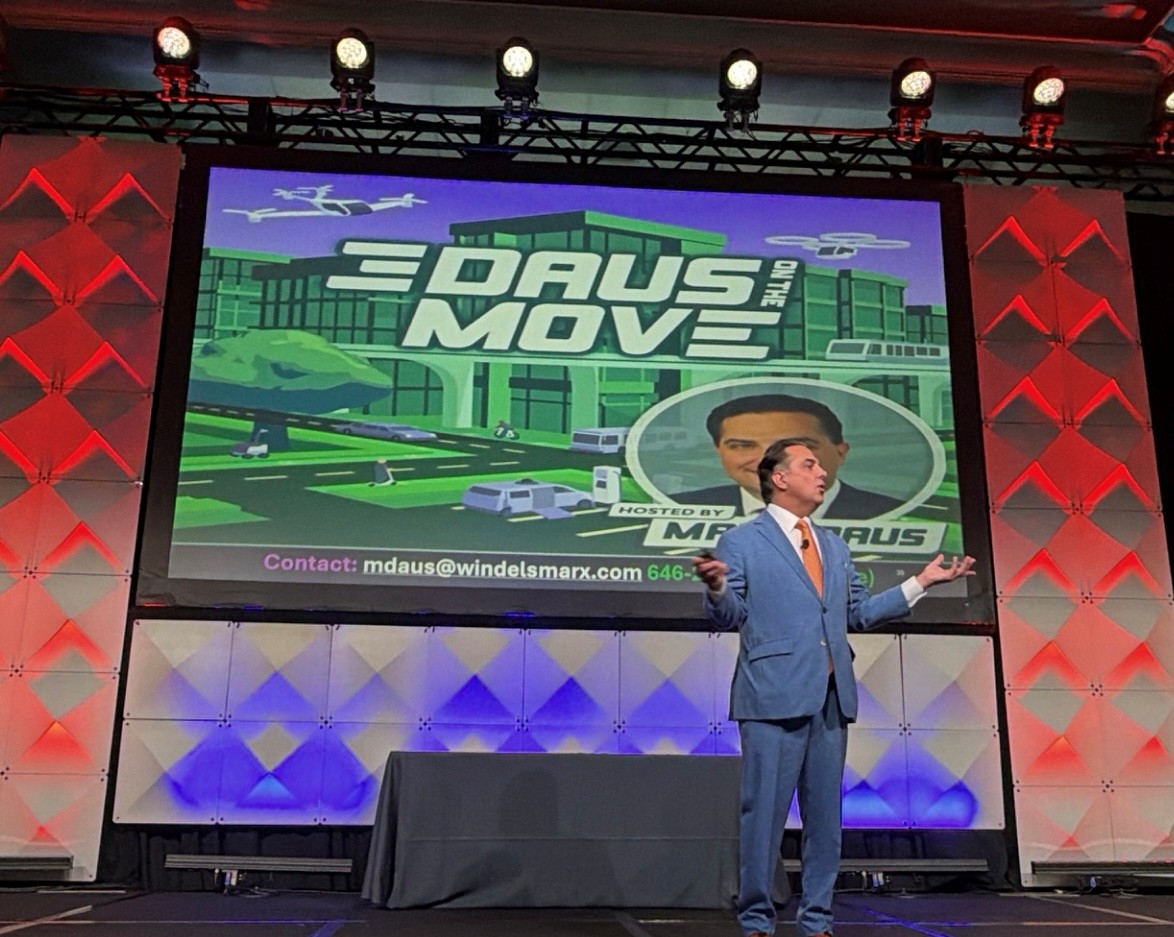
Matt Daus addressing the attendees at the NEMTAC Annual Conference.
The overwhelming majority of NEMT businesses are doing the right thing, and it is clearly a benefit to clear out the fraudsters and scammers from the industry. However, NEMT operators face unprecedented compliance risks. Given the increased federal and state scrutiny, I recommend NEMT providers take proactive steps to avoid getting caught up in these turbulent waters. The first step is to retain experienced healthcare transportation legal counsel to establish statutory compliance and navigate complex and ambiguous regulatory mandates. My team, for instance, helps NEMT businesses take the following measures to prevent investigations, and/or minimize risks from investigations:
- Annual Anti-Fraud Legal Check-Ups: Conduct systematic reviews of internal recordkeeping, trip log accuracy, driver qualification files, and billing protocols today, before government investigators call.
- Forensic & Data-Driven Self-Audits: Benchmark internal billing metrics against government fraud indicators to detect potential anomalies.
- Self-Disclosure Protocols: The use of official voluntarily self-disclosure channels to report billing discrepancies limits financial exposure.
- Technological Counseling: Telematics, AI and other tools can help detect anomalies and ensure compliance.
- Comprehensive Regulatory & Contractual Support: We provide advice on the full gamut of federal, state, and local licensing regimes. We also negotiate NEMT contracts with private brokers and public transit agencies, manage corporate governance and HIPAA compliance, handle wage and employment issues, and secure MWBE/DBE (Minority/ Disadvantaged Business Enterprise) certifications, as well as the proper state and local licenses to operate NEMT businesses.
If the NEMT business is already under investigation, a different set of steps is required – and again, learned counsel can help address the immediate and long-term impacts from potentially-adverse findings. There is a myriad of steps to take for investigation readiness, including documenting preservation protocols and implementation of a rapid-response playbook for subpoenas and other investigative inquiries. We have seen how these steps can help us negotiate a less debilitating resolution for a small business owner.

To learn more about our services for NEMT providers, please use this QR Code.
Also, Attorney General Offices (AGs) and Inspector General Offices (IGs) are increasingly relying on third-party monitors to provide assurances to funding agencies to continue doing business with providers that have adverse findings from audits/investigations, while allowing the business to continue serving patients. However, the details on these arrangements matter, and monitorship is a cost that can lead to a more reasonable result for the NEMT provider to continue to operate. The AG or IG would appoint an independent law or consulting firm that is certified and vetted to basically conduct supervision and oversight to ensure that the company has internal controls in place to prevent fraud in the future. Our firm also can serve as monitors, as part of a settlement, as our staff includes former judges and inspectors general, with experience overseeing Medicaid and Medicare funding investigations when they worked for the government.
Ultimately, NEMT providers that face a government inquiry, subpoena, or audit must understand their legal rights and statutory obligations. Unprepared responses can turn paperwork errors into adverse findings, and possible criminal prosecutions. One of the best ways to avoid an investigation is to understand the algorithmic triggers enforcement agencies are looking for, including unexplained spikes in mileage, trip counts or per-driver billing. The data indicates that about one-half of federal healthcare indictments result directly from inadequate or missing internal audits. By proactively identifying compliance gaps through internal audits, NEMT businesses can protect themselves from months or years of headaches.
A key preventive measure is the adoption of proactive anti-fraud compliance technology:
- GPS-Verified, Tamper-Evident Trip Capture: Eliminate manual trip logging by recording precise vehicle locations during passenger pickup and drop-off.
- Automated Trip-Logging: Relying on computer systems to record mileage effectively eliminates inflated mileage claims.
- Real-Time Matching: Automatically verify passenger Medicaid eligibility and cross-references transportation claims against medical appointment records at the time of booking.
- Automated Anomaly Flags: The state and federal authorities are looking for overlapping trip schedules, mileage versus GPS mismatches, and unusual repeat destination patterns – NEMT businesses should, too.
Another key step for NEMT businesses to take is obtaining formal accreditation from NEMTAC. That “Stamp of Approval” serves as proof of an operator’s commitment to compliance and ethical operations, because it demonstrates that the NEMT business strictly adheres to mandatory compliance benchmarks:
- Ethical Billing Compliance: Providing documented verification of compliance with NEMTAC standards designed to combat fraud, waste, and abuse.
- Curriculum Submission: Submitting comprehensive copies of internal organizational FWA education and training programs.
- Workforce Verification: Submitting verified employee and independent contractor rosters confirming that 100% of transport personnel have completed certified FWA training programs.
The NEMT industry faces an unprecedented convergence of heightened regulatory oversight, aggressive fraud enforcement, severe insurance market contraction, and rising litigation risks. Internal compliance audits and fleet safety measures are high priorities, not just another administrative task. By taking these steps now with their legal and operational teams, these small business owners will be making an investment today to prepare for the increasingly higher likelihood of audits and investigations, to minimize risks and disruptions – and to stay in business. With the scrutiny from federal and local investigative agencies and prosecutors, NEMT providers can expect a “knock at the door” at some point but can take the proactive steps now to minimize the impact of these government officials at the door.
This increased scrutiny is only going to intensify as preventing fraud, waste and abuse has become one of the top issues, politically – not just for the Congressional mid-term elections but for the next Presidential election in 2028. So, the “knocks on the door” will not just be campaign canvassers, but they might be from government investigators as well. I can assure you those knocks will become louder and more frequent in the coming years, so NOW is the time to prepare and protect your company and your clients/partners and customers.
Professor Matthew W. Daus, Esq. is President, International Associa-tion of Transportation Regulators (http://iatr.global/); Transportation Technology Chair, City University of New York, Transportation Research Center at The City College of New York (http://www.utrc2.org/); and Partner and Chairman, Windels Marx Transportation Practice Group (http://windelsmarx.com). He can be reached at mdaus@windelsmarx.com or 212.237.1106.