Multi-Modal Predictions & Analysis for Ground Transportation & Beyond
The incoming Democratic Congress will inherit a full agenda, including an overdue surface transportation funding bill, debates over electric vehicle charging, and decisions on whether and how to regulate autonomous vehicles. Remarkably, all that, and more, was on the list before the mid-November meltdown of the nation’s air traffic control systems, which stranded air passengers nationwide and is likely to be the biggest transportation policy story of the next few months.
I expect my fellow Brooklynites and friends, Chuck Schumer and Hakeem Jeffries, to become the Senate Leader and House Speaker, respectively. They are both champions for not only regulated ground transportation industries, but also for New York’s subway and bus riders, given their past fights for funding for nationally-significant mega-projects like the Gateway Program and the Second Avenue Subway.
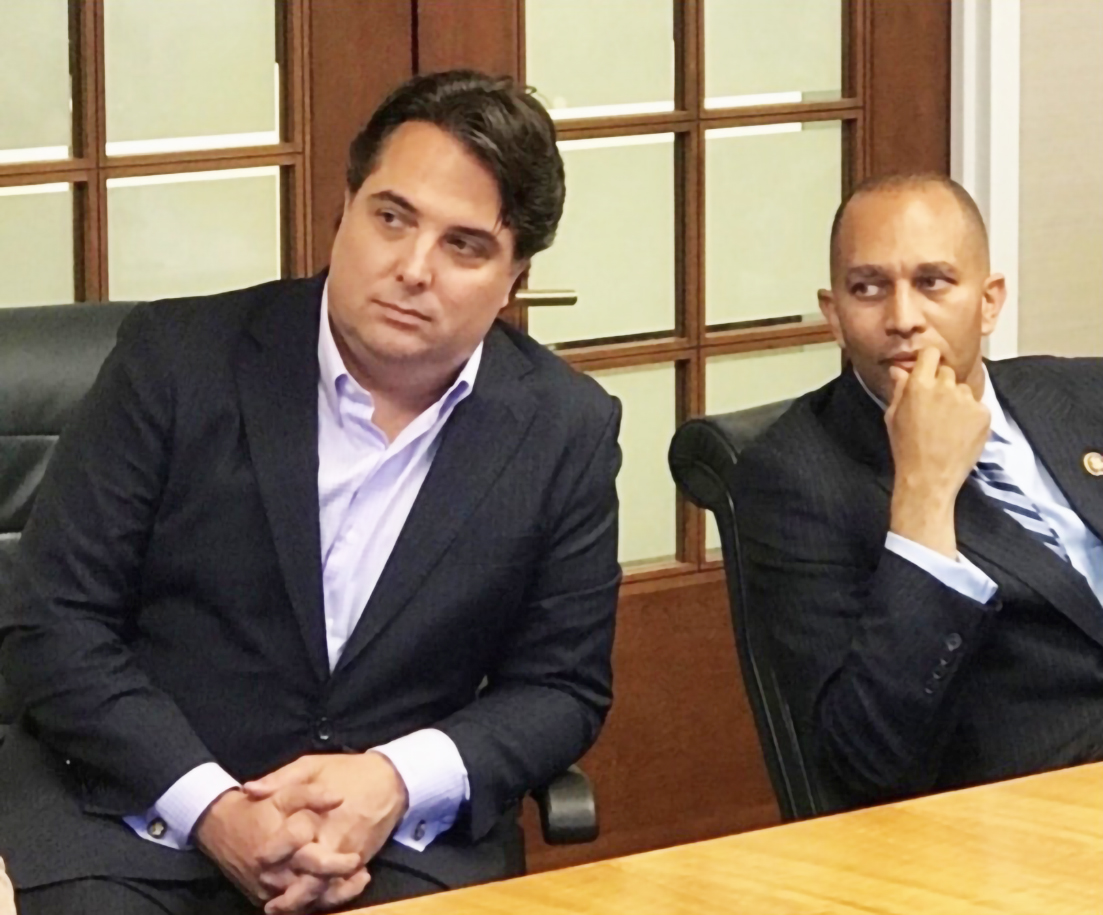
Matt Daus sits with Representative Hakeem Jeffries, the Future U.S. House Speaker, during a visit to the Windels Marx Law Office.
The question then becomes who will these leaders appoint as chairs of the relevant transportation committees? Representative Rick Larsen, a mainstream Democrat and veteran transportation policy leader from northwest Washington State, with a quarter-century on the House Transportation & Infrastructure Committee, is expected to become its next Chair and lead the House’s highway, transit, rail, and commercial transportation policy. Larsen will likely work with Senator Maria Cantwell, a fellow mainstream Democrat from Washington State, who is expected to return as Chair of the Senate Commerce, Science & Transportation Committee. As Chair in 2021, Senator Cantwell wrote and advanced major rail, freight, and infrastructure provisions of the Biden administration’s bipartisan infrastructure law. Oregon’s Senator Jeff Merkley, regarded as a liberal champion of environmental issues, is the leading contender for the Environment and Public Works Committee, which oversees highway infrastructure and electric vehicle charging policy. Senator Elizabeth Warren, from Massachusetts and perhaps the most liberal member of Congress, is expected to lead the Banking, Housing and Urban Affairs Committee, which oversees the Federal Transit Administration and transit funding. None of these appointments are set in stone, but these are the leaders who are expected to shape congressional transportation policy over the next two years.
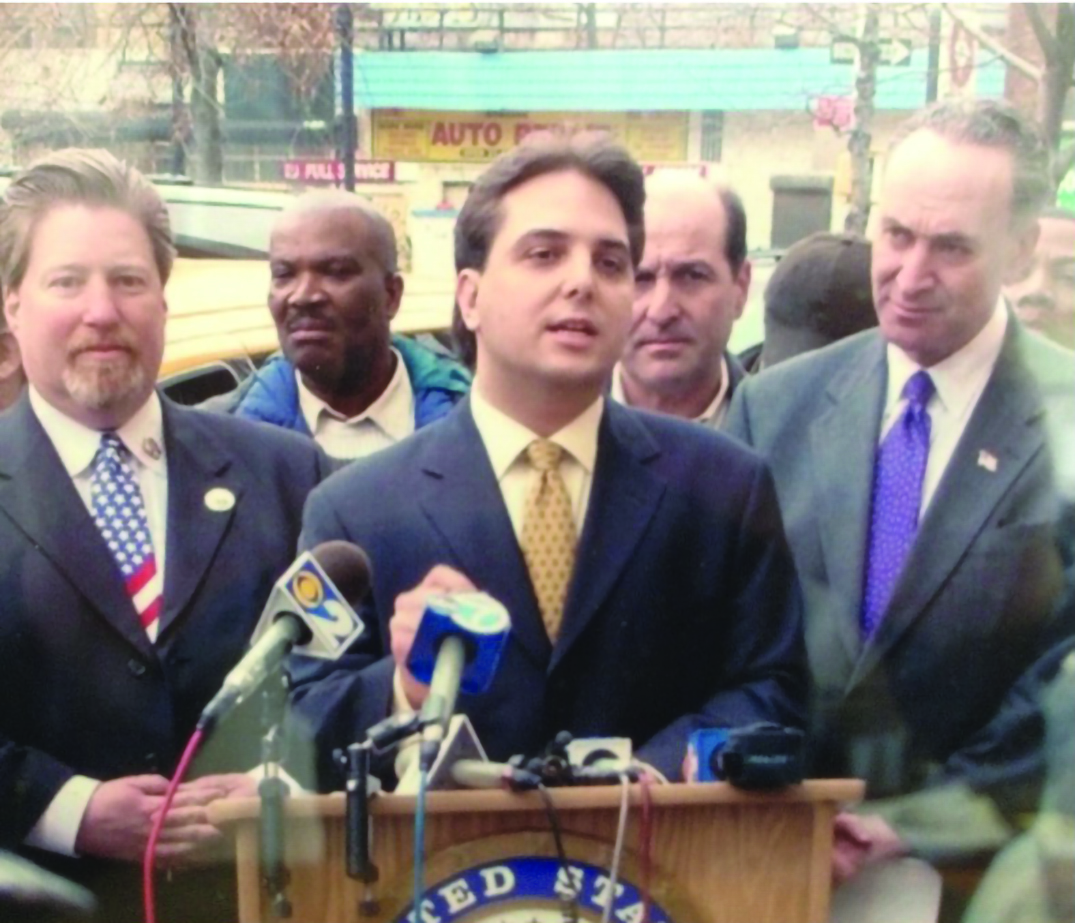
Matt Daus speaking at a press conference (center) many years ago with U.S. Senator Charles (Chuck) Schumer (far right), the future U.S. Senate Majority Leader. Joined at the podium are taxi leaders David Pollack (far left) and Neil Greenbaum (between Daus and Schumer).
What will the midterm election “blue wave” mean for the nation’s transportation agenda? Fred Ferguson, President of the American Bus Association (ABA), discussed what he expects. He predicts a resurgence of Blue Dog, pragmatic, nonideological Democrats, in part, because so many of the new members of the freshman class come from districts President Trump won by comfortable margins in 2016, 2020, or 2024. These members have strong incentives to prioritize sensible legislation that lowers household costs, supports small businesses, and delivers tangible transportation improvements. They are eager to cut through the culture-war noise that distracts from that agenda. Fred expects that pressure will trickle up to leadership, and as a result, there will be strong emphasis on pushing through common-sense legislation.
The next two years will reveal what Democrats can deliver. Here is what can be expected, and what that means for transportation and infrastructure priorities.
The Surface Transportation Funding Bill: Impacts on the FTA Taxi Exception for Public Paratransit & More!
The first major decision arrives in a few weeks, during the lame-duck session. The existing federal surface-transportation authorization expires on December 11, 2026. It is probable that Congress will extend funding into 2027 rather than pursue reauthorization during the lame duck session, because it is not close to finishing its work on the new bill, known as BUILD America 250. BUILD America 250 authorizes more than $580 billion in funding for roads, bridges, and transit, but it is more than a funding bill. It also sets the rules for how that money is spent and many of the policies by which our transportation systems operate.
Representative Rick Larsen is currently the Democrats’ lead on negotiating Build America 250 and has already said he expects much of the work to carry over to the next Surface Transportation Funding bill. That is big news because the bill contains a fix for the “FTA Taxi exception,” which exempts drivers from FTA drug-and-alcohol testing requirements on transit agency-funded paratransit trips when the passenger independently chooses the provider for each trip from two or more available taxi or ride-hail companies. The Build America 250 provision holds that if the transit agency gives passengers a choice between transportation providers and explains that those companies are not testing their drivers in the FTA program, the FTA testing regime would not apply. This is expected it to carry over into any Build America 250 successor.
BUILD America 250 would also increase Section 5310 funding for transportation for seniors and people with disabilities by roughly 10% in its first year, to $447.3 million. This funding helps expand specialized transportation programs for seniors and people with disabilities, including paratransit programs that go “above and beyond” the statutory requirements baseline that the FTA supports. The funding increase is expected to remain in the next ground transportation bill. It will be important to track whether Section 5310 is included in a Consolidated State Block Grant proposal, as proposed in the Surface Transportation Bill. If states can divert Section 5310 funds for other purposes, the impact of such a funding increase would be diminished.
Transportation “Affordability” is “Front & Center”: Impacts on the Legislative Agendas of the ABA, NLA & GBTA!
The new political zeitgeist term – “Affordability” – was a key narrative in the mid-term elections, and Democrats will be on the hunt for ways to show they are taking action to support Americans and small businesses. The good news is that smart transportation policy priorities align with that agenda.
The ABA’s legislative priorities align with these issues. Many of the ABA’s top items are sensible, nonideological solutions that will bring costs down for bus passengers and the small businesses that run bus companies. Requiring tolling authorities to discount bus company tolls to the same level as public transit agencies, allowing charter bus companies to use High-Occupancy Vehicle (HOV) lanes in the same way that public transit agency buses do, and protecting the federal fuel tax rebate for private motorcoach operators, are all already in Build America 250. It is likely to find those proposals carried forward in successor legislation, because these are pragmatic, non-ideological ways to bring down costs for working people. Similarly, small bus companies have had to contend with inconsistent idling prohibitions by local governments across the country, and paid millions in fines. This is especially problematic because bus companies have no choice but to pass the costs on to passengers, since modern bus engines are designed to idle whenever the bus is in service. The ABA-supported BUSES Act would standardize idling rules for buses and, therefore, advances the affordability agenda of protecting small businesses and shielding passengers from unnecessary expenses. While hopes remain high for common sense to prevail on the citizen complain anti-idling issue, there is some concern that the progressive Democrats that have backed this program in NYC might influence Congressional Democrats to stall or back-off this common-sense legislation. Only time will tell, but this will require extra industry efforts now to preserve momentum on this issue.
Another example of a common-sense, pragmatic transportation industry reform that can advance through the new Congress is the Staged Accident Fraud Prevention Act, supported by the ABA, Global Business Travel Association (GBTA) and the National Limousine Association (NLA), among a host of other groups. This bill makes it a federal crime to intentionally stage collisions with commercial motor vehicles and addresses the problem at the source by deterring the fraudsters, and the crooked attorneys and physicians who empower them, through criminal penalties. This bill improves safety and is a major step toward addressing the auto insurance crisis.
Another “home run” proposal to drive down costs for businesses, supported by the NLA, would be to waive the tax businessowners pay on gratuities. Brett Barenholtz, NLA President, recently addressed this legislative priority at the CD/NLA Conference in advance of the mid-term elections. Employees were granted a deduction to provide relief from FICA taxes on gratuities in the One Big Beautiful Bill Act of 2025. Combined with the “no taxes on overtime,” drivers received two immediate benefits to help reduce their federal taxes. With regard to the gratuities issue, the NLA is seeking to extend that same relief to small businesses to provide a major boost to their bottom line, and enable them to pass the savings on to consumers. Employers generally pay 6.2% in Social Security taxes, plus 1.45% in Medicare taxes on gratuities. The food services industry was exempted on the taxes for gratuities in the federal legislation. Exempting the employer’s share of the taxes on gratuities for the small businesses that are the heart of the NLA membership could therefore reduce payroll-tax costs by $765 for every $10,000 paid in gratuities, freeing cash for wages, equipment, or competing to win new customers by lowering prices.
Private Sector Competition in Microtransit Act: The TTA’s Proposed Legislation
One way to support microtransit may not necessarily be with more funding, but instead by requiring the funding that is out there be spent more wisely. The Transportation Alliance (TTA) has advocated that Congress should grow transit by supporting microtransit, a flexible, on-demand public transportation option that uses smaller vehicles, such as vans or shuttles, to transport passengers along dynamic or fixed routes. TTA will be asking Congress to reintroduce and pass the Private Sector Competition in Microtransit Act to make local transportation businesses the government’s collaborators in expanding mobility, rather than competitors against federally-subsidized operations. The proposal would require federal, state or locally-funded microtransit services to use transparent competitive contracting, prioritize small or disadvantaged businesses, and favor qualified local operators. The decision would follow an evaluation of cost-effectiveness and service quality. Importantly, the bill would also support local business growth, leading to a virtuous cycle. The TTA’s newly elected President, Bill George of Z-Trip et al., is expected to weigh-in soon on effort to modernize regulations, and like this bill, ensure fair competition and a level playing field for all mobility players in the space.
Expanding NEMT Funding & Combatting Fraud: Stakeholders Include the TTA, NEMTAC and IATR!
TTA is also asking that Congress expand non-emergency medical transportation (NEMT) through targeted federal matching funds, accessible-vehicle grants, and support for adequate provider reimbursement. Medicaid spends about $3 billion each year on NEMT, but the program saves $4 billion. That is because people who are undergoing chemotherapy or dialysis treatment could get severely sick, or worse, if they miss an appointment, which causes the cost of care to skyrocket. NEMT is only 1% of the Medicaid budget, and research indicates that expanding the program further could produce even greater savings. Congress should treat transportation as a cost-saving component of healthcare – not an optional extra.
Elena Sierra, TTA Executive Director, makes the case for these initiatives: “Expanding access to transportation does not always require more federal spending. It requires making smarter use of the resources we already have. By encouraging public-private partnerships in microtransit, Congress can support local transportation businesses, create jobs, and deliver more efficient services to communities. The same principle applies to non-emergency medical transportation. Helping patients get to essential medical appointments not only improves health outcomes, but also reduces costly hospitalizations and emergency care. Transportation should be viewed as an investment in stronger communities, better healthcare, and smarter government spending. We are working on legislation that accomplishes these goals.”
The International Association of Transportation Regulators (IATR) is planning a workshop at its 2027 Houston conference to not only address and study this important funding issue, but also to look at reforms to NEMT permitting programs among the states. IATR regulators and the industry alike are not sure what type of licenses to obtain, and while some companies have limousine, livery and taxi licenses to perform this work, others have resorted to TNC licensure and regulators are crying out for model regulations and uniformity. It is our hope that the IATR can be helpful to groups like the TTA and the Non-Emergency Medical Transportation Accreditation Commission (NEMTAC) on reforming not just the licensing process, but the NEMT social services agency approval process, as well as engaging to promote top-of-mind anti-fraud provisions. The road to 2028 and the Presidential election will have both the Democrats and Republicans stepping-over each other to try and show who is doing the better job of preventing Medicaid fraud, as this has become a major political issue for state and federal elections.
Tariffs
Tariffs are another major cost-driver for small transportation businesses. Although the U.S. Supreme Court struck down Trump’s emergency-powers tariffs in February 2026 (Learning Resources, Inc. v. Trump (2026)), its narrow ruling left tariffs imposed under other trade laws untouched. The administration’s tariffs on vehicles and replacement parts have increased operating costs, including insurance costs, for taxi and limousine, NEMT providers, trucking, and other fleet operators nationwide. Congress has constitutional authority over tariffs and could pass a bill to reduce the President’s tariff powers. The President, however, has the constitutional authority to veto Congress’ bills, and it would take a two-thirds vote in both chambers to override his veto. On this issue, gridlock may prevail. The throughline is clear on all of these issues: costs are out of control for the American consumer, but they can get relief if small business costs can be addressed with this pragmatic legislation.
Transit Funding
BUILD America 250 is slated, according to the American Public Transportation Association (APTA), to underfund transit by more than $16 billion. The New York Metropolitan Transportation Authority (MTA) warns that BUILD America 250 would shortchange that agency by $250 million alone. It is likely that transit agencies will see some of that funding restored in the next version of the Surface Transportation Funding Bill, particularly if Senate Leader Schumer and House Speaker Jeffries advocate for the funding for their hometown public transit system.
Tariffs are also a cost driver on transit budgets. The MTA alone still estimates it will pay nearly $1 billion in tariff costs for buses, trains, and other components that are unavailable domestically. The MTA is pushing to exempt that equipment from tariffs in the next surface transportation funding bill, and it may have a chance of succeeding because, unlike broader tariff reform efforts discussed earlier, this will be tucked into a much bigger bill.
One policy to watch is fare-free transit. Senator Warren co-sponsored the Freedom to Move Act of 2023, which proposed federal grants for fare-free transit. That bill did not advance, in part because many transit leaders do not consider fare-free transit a major priority. NYC Mayor Mamdani has advocated for free buses. Thus far, NYS Governor Hochul and the MTA have rejected the policy change. With the change in leader in Congress, it is possible that a fare-free transit initiative may be granted some pilot program funding.
Infrastructure
Over the last two years, the Trump Administration has sought to align infrastructure spending with its political and policy priorities. This manifested in fights over projects like the Gateway Program and the Second Avenue Subway in New York, and the withholding or delay of funding for an array of other transportation projects through the Department of Government Efficiency (DOGE) and other mechanisms. The new Congress can seek to insulate its spending from Executive Branch influence – or reach an agreement that will fast-track these projects. The time to fight over infrastructure spending policy is before Congress allocates the money.
One major project-delivery issue may happen before the new Congress arrives. The Senate has passed a bipartisan permitting overhaul intended to speed federal reviews of infrastructure projects, and House leaders
are considering action during the lame duck session. If enacted, it could reduce the amount of time major transportation projects take to move through federal approvals, which would be a welcome development.
Congestion Pricing
The Administration’s efforts to end New York City’s Congestion Pricing program in the courts have not been successful, and Democratic control of Congress makes legislation targeting the funding or authorization of the program harder to advance. Other cities, like Boston, Chicago, and Washington, D.C., have at least preliminary interest in starting up their own programs. Meanwhile, the U.S. Department of Transportation (USDOT) announced
$100 million in grant opportunities through the Federal Highway Administration’s Congestion Relief Program, and congestion pricing is one eligible use. It will be important to monitor if any of these other cities advance beyond preliminary interest.
Electric Vehicles
If Senator Merkley becomes Chair of the Senate Environment and Public Works Committee, his record on Electric Vehicle (EV) infrastructure portends that the new Congress will try to restore some of the Biden-era investments in EV charging and limit the Trump administration’s influence on this issue. Even so, Congress’ ability to compel USDOT Secretary Duffy to reestablish the Biden-era EV charging programs is limited. The BUILD America 250’s proposed annual fee on EV owners may remain in some form, because the Highway Trust Fund, which uses gas taxes to fund road construction, faces a severe deficit. It is harder to predict whether Democrats will prioritize restoration of EV tax incentives – although they may be popular. The issue requires a separate negotiation through the House Ways and Means and Senate Finance Committees, and it may not make the final list of priorities.
Autonomous Vehicles
Build America 250 includes a framework for AV freight trucks, motorcoaches, and similar commercial vehicle operations regulated by the Federal Motor Carriers Safety Administration (FMCSA). The bill addresses incident reporting, remote driving, accountability, and other issues. A chief aspect of the proposal is to allow AV companies to “self-certify” that their vehicles can safely operate on the nation’s roads. If appointed to lead the Senate Commerce, Science & Transportation Committee again, Senator Cantwell will have the opportunity to revise this bill. Senator Cantwell generally supports autonomous vehicles, but she has expressed skepticism about this type of permissive regulation and made clear that she believes the federal government needs to set rigorous standards and provide direct oversight. It would not be surprising to see these provisions fail to advance, at least in their current form. It may be more “trust but verify” than “self-certify.”
Aviation Safety
Following the November 13, 2026 airline ground stoppage, the Trump Administration requested $50 billion for air traffic control technology, towers, control centers, and airport infrastructure. It appears unlikely that Congress will approve that request during the lame duck session. Lawmakers in both parties want answers about the outage and the money already provided, and several Republican leaders have proposed a smaller, safety-focused package. It is not clear what the right funding level should be, but Republicans and Democrats have expressed skepticism that more money alone will solve it. Perhaps, a narrower investment package tied to clearer priorities and accountability will be able to advance through Congress and also have the support of the Trump Administration.
What’s Next?
Congressional Democrats will have the next two years to show that they can deliver on their campaign promises to address affordability. On transportation policy, however, the stage is mostly set, and without the White House, massive shifts in priorities may be unlikely. Congress’ attempts to change policy will have to contend with President Trump’s veto power, or his administration’s challenge of Congressional directives. Most change that does occur may be incremental, and around the edges. Interestingly, the biggest story of the next two years of congressional policymaking may be preparing for the next Presidential administration. We will continue to monitor the situation closely, and report back as developments take place. Now is a good time for the trade organizations and stakeholders to reassess their priorities, and try to align for bipartisan initiatives involved in every mode, with anti-fraud efforts and affordability being the key areas of possible collaboration.
Professor Matthew W. Daus, Esq. is President, International Association of Transportation Regulators (http://iatr.global/); Transporta-tion Technology Chair, City University of New York, Transportation Research Center at The City College of New York (http://www.utrc2. org/); and Partner and Chairman, Windels Marx Transportation Practice Group (http:// windelsmarx.com). He can be reached at mdaus@windelsmarx.com or 212.237.1106.


